
创意预览图

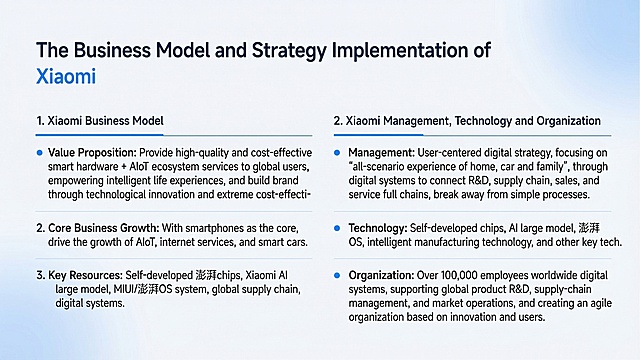
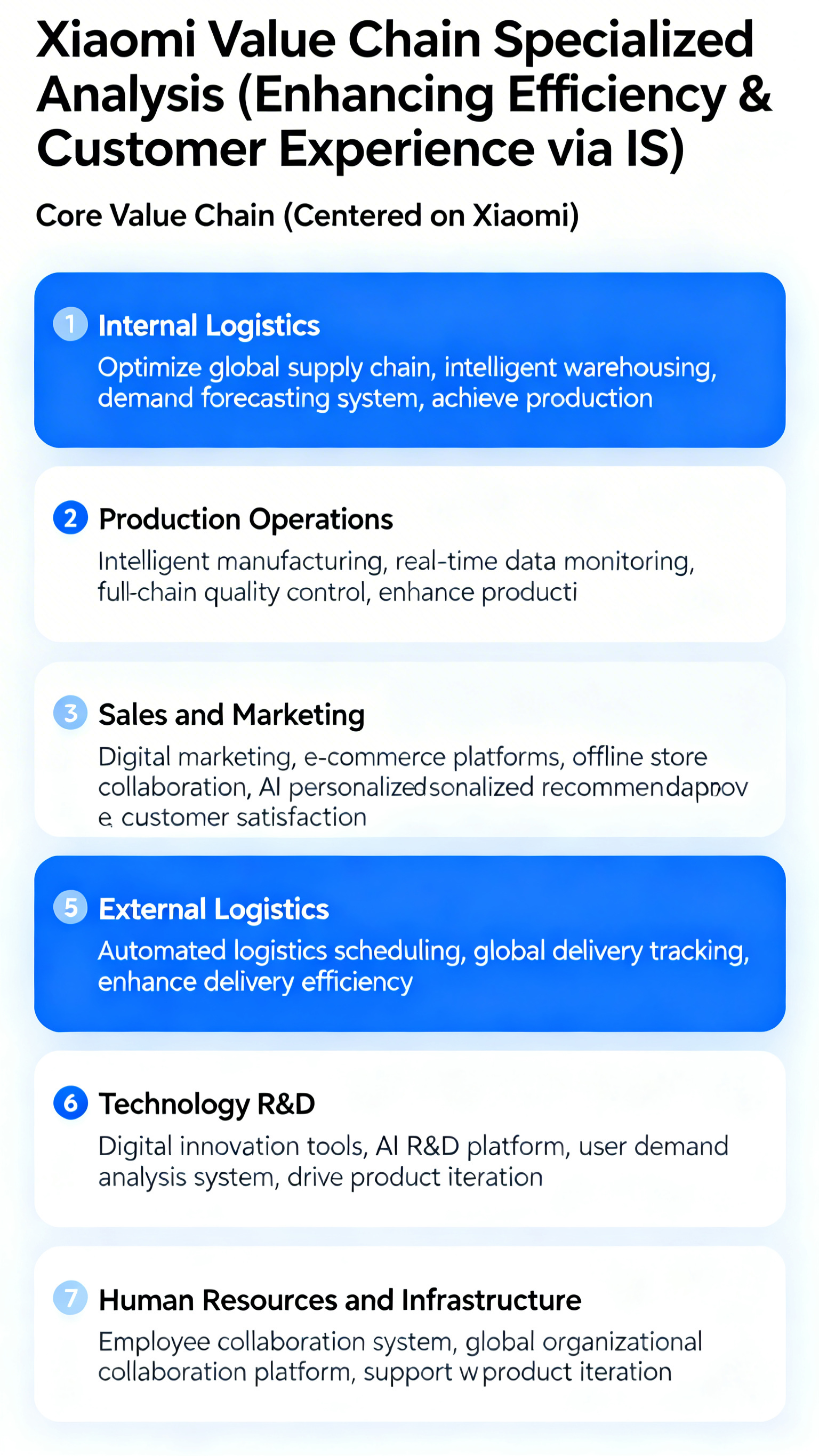
一张商务信息图表,标题为"Xiaomi Value Chain Specialized Analysis (Enhancing Efficiency & Customer Experience via

用户头像

1qxzrcro07x...

2026.04.09
仿照原图的排版和布局风格,替换文字内容为:顶部标题栏替换为小米Logo,大标题改为'The Value Chain of Xiaomi Enterprises (Firm Value Chain)',副标题改为'Enhancing Efficiency & Customer Experience with Information Systems';将基本活动区域内容替换为:1. 第一栏Internal Logistics (Inbound Logistics):Automated warehousing system, intelligent inventory management system, raw material supply chain traceability system;2. 第二栏Production Operations (Operations):Intelligent manufacturing systems, computer-controlled Production processing systems, factory IoT monitoring systems, quality traceability systems;3. 第三栏留空保持圆形中心,中心圆形替换为小米Logo,文字改为'Xiaomi Value Chain Model';4. 第四栏Sales and Marketing (Sales and Marketing):Xiaomi Mall, e-commerce platform order system, digital marketing system, user operation platform, offline store management system;5. 第五栏Customer Service (Service):Xiaomi customer service system, equipment remote diagnosis system, after-sales order management system, user feedback analysis system;6. 底部左侧Support Activities Technology Research and Development:Computer-Aided Design (CAD) System, Chip Design EDA Tools, AI Large Model Training Platform, IoT Device Interconnection Technology Research and Development System;底部右侧分两部分,上方Human Resources:Talent Planning System, Employee Performance and Training System, Remote Collaborative Office Platform;下方分为两部分,左侧Administrative Management and Management:Enterprise Digital OA, Electronic Scheduling and Collaborative Office System, Global Supply Chain Management System,右侧Procurement Management:Computerized Purchase Order System, Global Supply Chain Centralized Procurement Platform, Supplier Collaboration Management System;底部小字改为'Information System Optimizes Xiaomi Value Chain',保持整体配色和图标风格一致。仿照原图的排版和布局风格,替换文字内容为:顶部标题栏替换为小米Logo,大标题改为'The Value Chain of Xiaomi Enterprises (Firm Value Chain)',副标题改为'Enhancing Efficiency & Customer Experience with Information Systems';将基本活动区域内容替换为:1. 第一栏Internal Logistics (Inbound Logistics):Automated warehousing system, intelligent inventory management system, raw material supply chain traceability system;2. 第二栏Production Operations (Operations):Intelligent manufacturing systems, computer-controlled Production processing systems, factory IoT monitoring systems, quality traceability systems;3. 第三栏留空保持圆形中心,中心圆形替换为小米Logo,文字改为'Xiaomi Value Chain Model';4. 第四栏Sales and Marketing (Sales and Marketing):Xiaomi Mall, e-commerce platform order system, digital marketing system, user operation platform, offline store management system;5. 第五栏Customer Service (Service):Xiaomi customer service system, equipment remote diagnosis system, after-sales order management system, user feedback analysis system;6. 底部左侧Support Activities Technology Research and Development:Computer-Aided Design (CAD) System, Chip Design EDA Tools, AI Large Model Training Platform, IoT Device Interconnection Technology Research and Development System;底部右侧分两部分,上方Human Resources:Talent Planning System, Employee Performance and Training System, Remote Collaborative Office Platform;下方分为两部分,左侧Administrative Management and Management:Enterprise Digital OA, Electronic Scheduling and Collaborative Office System, Global Supply Chain Management System,右侧Procurement Management:Computerized Purchase Order System, Global Supply Chain Centralized Procurement Platform, Supplier Collaboration Management System;底部小字改为'Information System Optimizes Xiaomi Value Chain',保持整体配色和图标风格一致。
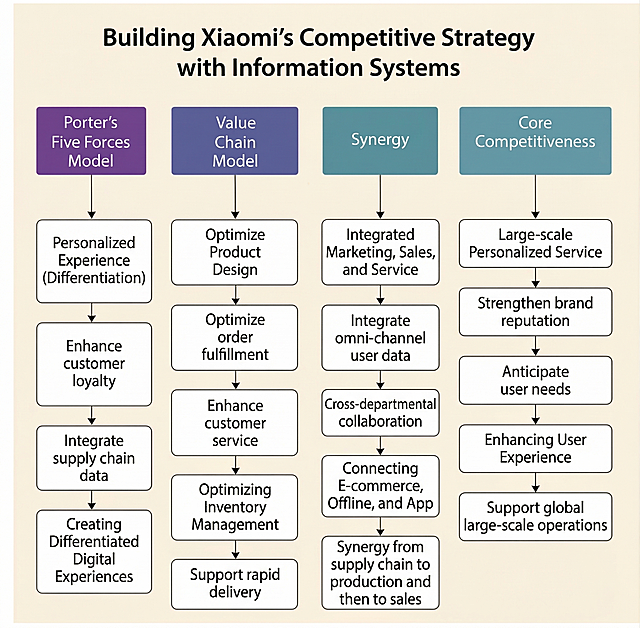
保持这张小米波特五力分析图的整体布局、logo位置、配色和版式不变,将所有中文分析内容替换回原始完整英文内容,确保图片中没有中文,英文排版整齐清晰。完整英文内容: 1 Existing Competitors (Intra-industry Competition) Threat Level: Extremely High The competition in the smartphone, smart home, and IoT sectors is extremely fierce. Direct rivals include Huawei, OPPO, vivo, and Apple. Meanwhile, in the white goods and notebook sectors, it faces intense competition from brands such as Midea, Gree, and Lenovo. Price wars, technology battles, and ecosystem wars continue to escalate. 2 Threat of new market entrants Threat level: Medium to low The research and development, supply chain, and brand barriers for smartphones, high-end chips, and IoT ecosystems are extremely high, making it difficult for new players to break through. However, in niche segments (such as smart wearables and small household appliances), there is still a possibility for small and medium-sized brands to enter the market. 3 Threat of substitute products/services Threat level: Medium to high Feature phones, traditional household appliances, and non-smart hardware pose a substitution threat to Xiaomi's smart products. Meanwhile, tablets and 2-in-1 laptops are substitutes for entry-level mobile phones and laptops. In overseas markets, local brands will also divert users. 4 The bargaining power of suppliers Threat level: Moderate Suppliers of core components (such as chips, screens, and batteries) like Qualcomm, Samsung, and BOE have strong bargaining power. However, Xiaomi has significantly weakened the suppliers' influence through self-developed chips (Pengpai), large-scale centralized procurement, and deep binding of the supply chain. 5 The bargaining power of buyers (customers) Threat level: High There are numerous consumer choices, and they are highly sensitive to price, configuration, and ecological experience. The replacement cycle of devices has been prolonged, and users' demands for cost-effectiveness and service continue to rise, resulting in strong bargaining power.保持这张小米波特五力分析图的整体布局、logo位置、配色和版式不变,将所有中文分析内容替换回原始完整英文内容,确保图片中没有中文,英文排版整齐清晰。完整英文内容:
1 Existing Competitors (Intra-industry Competition)
Threat Level: Extremely High
The competition in the smartphone, smart home, and IoT sectors is extremely fierce. Direct rivals include Huawei, OPPO, vivo, and Apple. Meanwhile, in the white goods and notebook sectors, it faces intense competition from brands such as Midea, Gree, and Lenovo. Price wars, technology battles, and ecosystem wars continue to escalate.
2 Threat of new market entrants
Threat level: Medium to low
The research and development, supply chain, and brand barriers for smartphones, high-end chips, and IoT ecosystems are extremely high, making it difficult for new players to break through. However, in niche segments (such as smart wearables and small household appliances), there is still a possibility for small and medium-sized brands to enter the market.
3 Threat of substitute products/services
Threat level: Medium to high
Feature phones, traditional household appliances, and non-smart hardware pose a substitution threat to Xiaomi's smart products. Meanwhile, tablets and 2-in-1 laptops are substitutes for entry-level mobile phones and laptops. In overseas markets, local brands will also divert users.
4 The bargaining power of suppliers
Threat level: Moderate
Suppliers of core components (such as chips, screens, and batteries) like Qualcomm, Samsung, and BOE have strong bargaining power. However, Xiaomi has significantly weakened the suppliers' influence through self-developed chips (Pengpai), large-scale centralized procurement, and deep binding of the supply chain.
5 The bargaining power of buyers (customers)
Threat level: High
There are numerous consumer choices, and they are highly sensitive to price, configuration, and ecological experience. The replacement cycle of devices has been prolonged, and users' demands for cost-effectiveness and service continue to rise, resulting in strong bargaining power.
逻辑严密的商业战略流程图,蓝白色系。中心位置是一个圆形,内部标注"数据洞察与决策中枢",代表项目的核心决策大脑,基于用户评论情感分析、RFM用户分层、ARIMA销售预测等分析模型。围绕中心圆形将画面划分为四个象限: 象限A(产品与内容优化):包含放大镜、文档/标签、FDA/CPSC认证徽章图标;箭头从中枢指向该象限,标注"用户痛点驱动",输出"优化后的详情页/A+"、"合规信任背书"。 象限B(站内流量精细化运营):包含亚马逊Logo、放大镜、广告标志图标;箭头从中枢指向该象限,标注"关键词策略与用户画像",输出"SP/SB广告"、"高转化Listing"。 象限C(站外场景化内容种草):包含TikTok/YouTube Logo、摄像机、露营后院场景简笔画图标;箭头从中枢指向该象限,标注"场景叙事与痛点可视化",输出"AIGC生成视频"、"KOL/KOC内容"。 象限D(供应链协同与风险管控):包含工厂/齿轮、盾牌图标;双向箭头:中枢→D标注"产品定义反馈",D→中枢标注"产能与合规保障"。 数据流闭环:内圈B、C象限连接到"亚马逊销售与用户数据"池再回中枢,形成执行-数据回收-分析优化小循环。外圈D象限连接A象限,表示供应链生产符合营销承诺的产品;"亚马逊销售与用户数据"池连接D象限,表示市场反馈驱动供应链调整。所有数据流最终汇入中枢,形成完整循环,体现"数据驱动决策,决策指导实践,实践产生新数据,数据反哺优化"的核心理念。逻辑严密的商业战略流程图,蓝白色系。中心位置是一个圆形,内部标注"数据洞察与决策中枢",代表项目的核心决策大脑,基于用户评论情感分析、RFM用户分层、ARIMA销售预测等分析模型。围绕中心圆形将画面划分为四个象限:
象限A(产品与内容优化):包含放大镜、文档/标签、FDA/CPSC认证徽章图标;箭头从中枢指向该象限,标注"用户痛点驱动",输出"优化后的详情页/A+"、"合规信任背书"。
象限B(站内流量精细化运营):包含亚马逊Logo、放大镜、广告标志图标;箭头从中枢指向该象限,标注"关键词策略与用户画像",输出"SP/SB广告"、"高转化Listing"。
象限C(站外场景化内容种草):包含TikTok/YouTube Logo、摄像机、露营后院场景简笔画图标;箭头从中枢指向该象限,标注"场景叙事与痛点可视化",输出"AIGC生成视频"、"KOL/KOC内容"。
象限D(供应链协同与风险管控):包含工厂/齿轮、盾牌图标;双向箭头:中枢→D标注"产品定义反馈",D→中枢标注"产能与合规保障"。
数据流闭环:内圈B、C象限连接到"亚马逊销售与用户数据"池再回中枢,形成执行-数据回收-分析优化小循环。外圈D象限连接A象限,表示供应链生产符合营销承诺的产品;"亚马逊销售与用户数据"池连接D象限,表示市场反馈驱动供应链调整。所有数据流最终汇入中枢,形成完整循环,体现"数据驱动决策,决策指导实践,实践产生新数据,数据反哺优化"的核心理念。
生成一张美观有设计感的信息图,主标题是"B2B 买家 AI 查询的六大行为转变",副标题标注"根据 GrowthSpree 2026 年的数据追踪研究"。内容分为六个板块,依次展示六个转变: 1. 转变 #1:供应商短名单行为改变,文案:从研究 7-12 家供应商 → 直接进入 2-4 家 AI 预选供应商,AI 的推荐列表 = 现代 B2B 采购的"守门人" 2. 转变 #2:表单填写行为崩塌,文案:67% 的 B2B 买家在研究过程中不填写任何表单(2024 年为 41%),买家偏好 AI 搜索研究,因为:(a) 更快;(b) 无需注册摩擦;(c) AI 一次查询提供多供应商视角,MQL 驱动的 GTM 模型错过了 67% 的 B2B 买家——这是结构性问题 3. 转变 #3:研究时间压缩,文案:完整供应商研究周期从 14-21 天压缩到 5-9 天(60-65% 压缩),供应商的响应速度和内容深度成为决定性因素 4. 转变 #4:直达深度内容,文案:买家跳过首页,直接访问案例研究、定价、对比页,内容结构必须支持"从中间开始阅读" 5. 转变 #5:Demo 请求质量跃升,文案:请求 Demo 的买家携带的具体问题比 2024 年多 40-60%,他们已通过 AI 完成了大量预研究 6. 转变 #6:品牌提及模式转变,文案:买家仅在 AI 搜索引用中正确提及你的品牌时,才会引用你,如果 AI 错误地呈现你的品牌信息,买家会形成错误认知 整体采用商务科技风格,排版清晰,用蓝色和灰色为主色调,每个转变用卡片分区展示,配色专业协调,适合商业报告分享。生成一张美观有设计感的信息图,主标题是"B2B 买家 AI 查询的六大行为转变",副标题标注"根据 GrowthSpree 2026 年的数据追踪研究"。内容分为六个板块,依次展示六个转变:
1. 转变 #1:供应商短名单行为改变,文案:从研究 7-12 家供应商 → 直接进入 2-4 家 AI 预选供应商,AI 的推荐列表 = 现代 B2B 采购的"守门人"
2. 转变 #2:表单填写行为崩塌,文案:67% 的 B2B 买家在研究过程中不填写任何表单(2024 年为 41%),买家偏好 AI 搜索研究,因为:(a) 更快;(b) 无需注册摩擦;(c) AI 一次查询提供多供应商视角,MQL 驱动的 GTM 模型错过了 67% 的 B2B 买家——这是结构性问题
3. 转变 #3:研究时间压缩,文案:完整供应商研究周期从 14-21 天压缩到 5-9 天(60-65% 压缩),供应商的响应速度和内容深度成为决定性因素
4. 转变 #4:直达深度内容,文案:买家跳过首页,直接访问案例研究、定价、对比页,内容结构必须支持"从中间开始阅读"
5. 转变 #5:Demo 请求质量跃升,文案:请求 Demo 的买家携带的具体问题比 2024 年多 40-60%,他们已通过 AI 完成了大量预研究
6. 转变 #6:品牌提及模式转变,文案:买家仅在 AI 搜索引用中正确提及你的品牌时,才会引用你,如果 AI 错误地呈现你的品牌信息,买家会形成错误认知
整体采用商务科技风格,排版清晰,用蓝色和灰色为主色调,每个转变用卡片分区展示,配色专业协调,适合商业报告分享。
设计一张专业商务信息图,内容为B2B GEO四大核心策略框架之策略四:跨平台共识(Cross-Platform Consensus)—— AI 的"信任投票"。包含以下完整文字内容: B2B 专业服务公司 GEO 研究显示,AI 引擎选择引用哪家企业时,遵循两个核心条件: 共识(Consensus):多个可信来源都提到你 一致性(Consistency):你的品牌叙事在所有平台上一致 AI 信任的"共识来源"层级表格: 层级 来源类型 权重 B2B 行动 Tier 1 行业分析师 ★★★★★ 争取进入 Magic Quadrant、Wave 报告;与分析师建立关系 Tier 2 权威行业媒体 ★★★★★ 通过 PR 获得专题报道;高管署名文章 Tier 3 评论平台 ★★★★☆ 主动获取详细客户评价;回应所有评论;保持评分活跃 Tier 4 社区与论坛 ★★★☆☆ 参与专业讨论;分享真实案例;避免过度推广 Tier 5 合作伙伴与客户背书 ★★★☆☆ 客户案例、合作伙伴页面、联合白皮书 Tier 6 自有渠道(官网、博客、社交媒体) ★★☆☆☆ 结构化内容、FAQ、Schema 标记;这是基础,但不足够 关键洞察:85% 的 AI 品牌提及来自第三方页面(AirOps 2026)。这意味着仅靠官网内容远远不够——AI 引擎需要"外部验证"。 跨平台一致性检查清单: 品牌描述在所有平台上使用相同的核心信息(2-3 句标准描述) 产品分类和标签在各平台一致(G2、Capterra、官网、LinkedIn) 客户评价中的关键词在各平台一致("易用性"、"客户支持服务"等) 定价信息在所有平台一致(避免 AI 提取矛盾信息) 公司规模、成立时间、总部位置等基本信息一致 整体风格简约商务,深蓝色科技感背景,清晰的层级排版,保留所有文字信息,美观有设计感,适合商务分享使用。设计一张专业商务信息图,内容为B2B GEO四大核心策略框架之策略四:跨平台共识(Cross-Platform Consensus)—— AI 的"信任投票"。包含以下完整文字内容:
B2B 专业服务公司 GEO 研究显示,AI 引擎选择引用哪家企业时,遵循两个核心条件:
共识(Consensus):多个可信来源都提到你
一致性(Consistency):你的品牌叙事在所有平台上一致

AI 信任的"共识来源"层级表格:
层级	来源类型	权重	B2B 行动
Tier 1	行业分析师	★★★★★	争取进入 Magic Quadrant、Wave 报告;与分析师建立关系
Tier 2	权威行业媒体	★★★★★	通过 PR 获得专题报道;高管署名文章
Tier 3	评论平台	★★★★☆	主动获取详细客户评价;回应所有评论;保持评分活跃
Tier 4	社区与论坛	★★★☆☆	参与专业讨论;分享真实案例;避免过度推广
Tier 5	合作伙伴与客户背书	★★★☆☆	客户案例、合作伙伴页面、联合白皮书
Tier 6	自有渠道(官网、博客、社交媒体)	★★☆☆☆	结构化内容、FAQ、Schema 标记;这是基础,但不足够

关键洞察:85% 的 AI 品牌提及来自第三方页面(AirOps 2026)。这意味着仅靠官网内容远远不够——AI 引擎需要"外部验证"。

跨平台一致性检查清单:
品牌描述在所有平台上使用相同的核心信息(2-3 句标准描述)
产品分类和标签在各平台一致(G2、Capterra、官网、LinkedIn)
客户评价中的关键词在各平台一致("易用性"、"客户支持服务"等)
定价信息在所有平台一致(避免 AI 提取矛盾信息)
公司规模、成立时间、总部位置等基本信息一致

整体风格简约商务,深蓝色科技感背景,清晰的层级排版,保留所有文字信息,美观有设计感,适合商务分享使用。