已添加
登录/注册
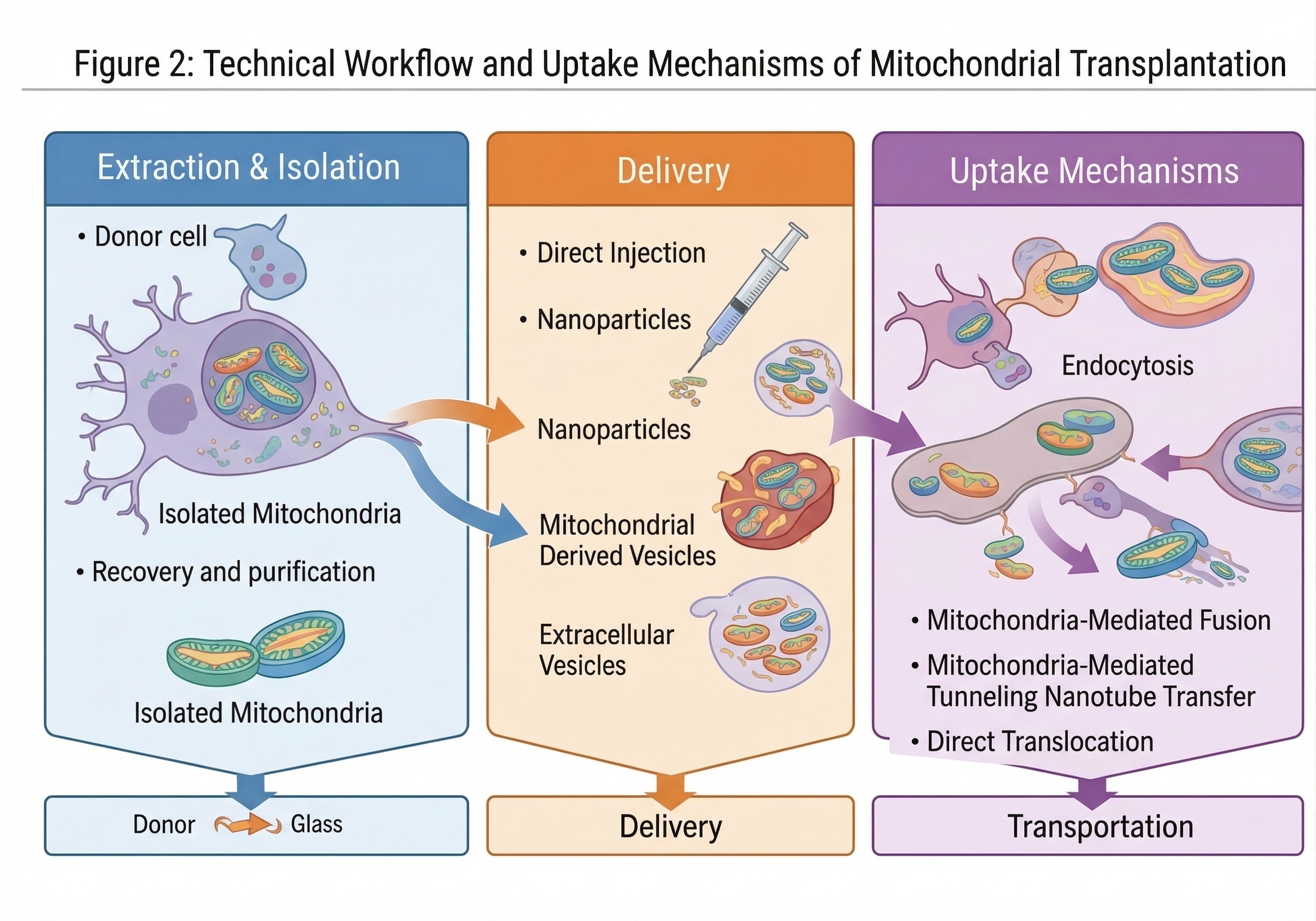
学术流程图,线粒体移植技术流程和摄取机制,保留所有文字信息和排…
学术流程图,线粒体移植技术流程和摄取机制,保留所有文字信息和排版结构,使用和第二张图一致的简约清晰写实生物学术插画风格,干净扁平化配色,不要AI艺术化效果
1qv7pcjlk7o...
2026.03.26
做同款
Ultra-detailed scientific illustration, flat vector style, showcasing the process of "Triparental Mating" for bacterial plasmid transfer. The image is divided into three clear stages from left to right. Stage 1: Three distinct bacterial cells in close proximity. 1 Donor E. coli: Contains a "mobilizable plasmid" with a visible "gene of interest" (like a fluorescent protein or antibiotic resistance marker) and an "oriT" site. 2 Helper E. coli: Contains a "conjugative plasmid" with visible "tra genes" (transfer genes) and pilus structures. 3 Recipient bacterium (e.g., a Rhizobium cell): Has a different cell wall shape, labeled, with no plasmid inside. Stage 2: The helper E. coli extends a "pilus" (a thin tube) to attach to the donor E. coli. The conjugative plasmid's tra genes mobilize the mobilizable plasmid. Show a clear arrow indicating the transfer of the mobilizable plasmid FROM the donor TO the helper cell. Stage 3: The helper E. coli, now carrying the mobilizable plasmid, extends a new pilus to attach to the recipient bacterium. Show a second arrow indicating the final transfer of the mobilizable plasmid INTO the recipient. The recipient bacterium now contains the plasmid. Use a distinct, consistent color scheme: Donor is Blue, Helper is Orange, Recipient is Green, Mobilizable Plasmid is Red, Conjugative Plasmid is Yellow. The background is clean white. All key elements have clear labels with leader lines. The style is educational, schematic, and extremely clear for a presentation slide.
Poiuyt·
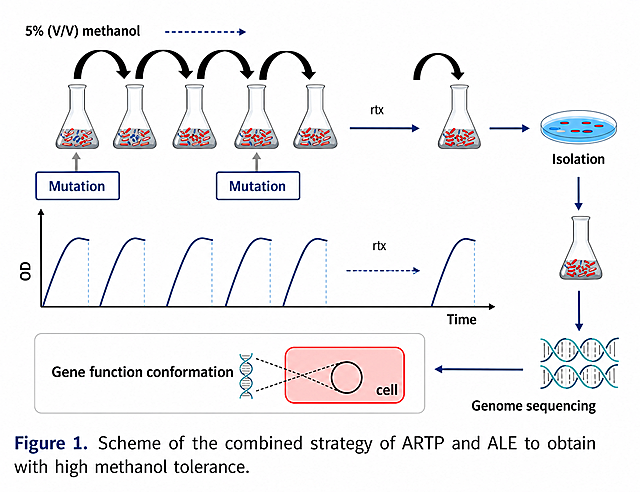
修改这张科研示意图:1. 将左上角的'5% (V/V) methanol'改为'6% (V/V) methanol';2. 在右侧测序部分,将原来的'Genome sequencing'扩展为四个组学,从上到下依次纵向排列:Genome sequencing(基因组测序,DNA双螺旋图标)、Transcriptome sequencing(转录组测序,RNA链图标)、Proteome sequencing(蛋白组测序,蛋白质三维结构图标)、Metabolome(代谢组,小分子代谢物图标),四个组学都有箭头指向左侧的Gene function conformation区域;3. 去掉底部的'Figure 1. Scheme of the combined strategy of ARTP and ALE to obtain with high methanol tolerance.'整段图注文字;4. 保持整体专业矢量学术风格、白底、其他元素和流程结构不变。
GD760854844
「图片1」太像了,在区别大一写
dayandda123
绘制一幅微生物作用机理图,将图片清晰分离为细胞内和细胞外两个部分。细胞外部分标注:模块1 光能捕获与能量代谢,850 nm匹配细菌叶绿素a核心吸收峰;模块2 大分子降解与底物利用,HMW组分>20 kDa降解59.1%,芳香蛋白I/II利用率>50%,提供碳骨架和氮源。细胞内部分标注:模块3 蛋白质质量控制,DnaK/GroEL/GroES/clpA协同上调,促进正确折叠与清除损伤蛋白,维持蛋白质稳态;模块4 翻译与氨基酸合成,EF-G和EF-Tu上调保障翻译通量,17种氨基酸,21.5%干重,含全部必需氨基酸;模块5 胞内代谢优先策略,胞内蛋白上调,胞外分泌下调,能量集中于SCP合成,体现胞内优先策略;模块6 群落与网络调控,Shannon指数6.65,多样性最高,ilvC/ilvE/leuA协同模块,酶-微生物网络负相关为主。整体为清晰的科学机理图,模块划分清晰,文字标注准确,专业科研风格,采用蓝色简约配色,细胞内外用不同颜色背景区分。
1r5741wmrnCJt1kQ-HB
参考图中的免疫学机制图风格(左侧胸腺Thymus区域、右侧外周Periphery区域、细胞卡通图标、箭头信号通路、分子标注、蛋白标记框),生成一张"免疫调节与Treg细胞分化机制模型"图。画面布局:左上为胸腺(Thymus)区,展示TEC细胞、初始T细胞分化为nTreg(天然调节性T细胞,Foxp3+红色细胞),标注CD25、Foxp3、CD39/73、LAG-3、CTLA-4、CD40、CD80/86、OX40、GITR等表面分子;右侧为外周(Periphery)区,展示iTreg(诱导性调节性T细胞)分化通路:包括Tconv(常规T细胞)在TGF-β、IL-10、IL-35作用下分化为Foxp3+ iTreg,Tr1细胞(分泌IL-10),Th3细胞(分泌TGF-β);下方展示APC抗原呈递细胞、DC树突状细胞(CD103+)与Treg的相互作用,标注GPR43/GPR109A、SCFA短链脂肪酸、视黄酸RA、CCR9/α4β7归巢受体、向GALT肠道相关淋巴组织迁移;右侧展示Treg的外周维持机制(IL-2、TGF-β、Foxp3+)。整体风格:细胞用彩色圆形卡通图标表示,分子用小圆点/三角形表示,黑色箭头指示分化和信号方向,白色方框标注分子标记,浅米色分区背景,绿色边框,专业学术示意图风格,英文标注为主,顶部大标题"免疫调节与Treg细胞分化机制模型"。
绎雪雪
横版信息图,展示血浆蛋白组实验两大核心痛点:1.蛋白动态范围跨度极大,低丰度标志物难以检出,图示高丰度蛋白掩盖低丰度蛋白;2.手工处理通量低、批次差异严重,对比手工操作和自动化流程差异,科技风,蓝色商务配色
1q0vx9wwh3si5r2e-HB
删除最上方标题文字,删除(e.g.,NF-kB)、(e.g.,cAMP)、Pro-inflammatory Polarization、Anti-inflammatory Polarization文字,将CCL2替换为IL-1β,增加抗炎因子TGF-β,保持其余内容和布局不变
青年有故事
优化这张科研示意图,保持所有内容元素和流程结构不变:ARTP诱变与ALE结合策略获得高甲醇耐受性菌株的实验流程图。提升画面为专业学术期刊级别的高质量矢量风格,线条清晰流畅,色彩协调专业,图标精致美观,文字排版整齐规范,整体干净整洁,白底背景,适合学术论文发表。保留所有英文标注文字和箭头流向。
GD760854844
Biomedical schematic diagram for high-impact journal publication in Nature Reviews style, showing three core pathological mechanisms of infected wounds: (1) persistent inflammation and macrophage polarization imbalance including LPS/TLR4/NF-κB pathway, M1 macrophages, TNF-α/IL-1β/IL-6, (2) ROS overload-mediated cellular damage including ROS, SOD, CAT, glutathione, MMPs, (3) drug-resistant bacterial biofilm formation including extracellular polymeric substances, eDNA. Central image shows a skin wound cross-section with Staphylococcus aureus and Pseudomonas aeruginosa. Color palette: dark blue, crimson, and gray with gradient backgrounds. Molecules are shown as simplified sphere-and-stick models. Clean, professional layout, sans-serif fonts (Arial/Helvetica), top-tier journal quality and texture
GD442223348
Biomedical schematic of three core pathological mechanisms in infected wounds, in Nature Reviews style. Center shows a skin wound cross-section with Staphylococcus aureus and Pseudomonas aeruginosa. Three branches radiate out: left branch labeled "persistent inflammation & macrophage dysregulation" showing the pathway LPS→TLR4→NF-κB, M1 macrophages colored in red, with cytokines TNF-α/IL-1β/IL-6 labeled; right branch labeled "ROS overload" indicating ROS burst, SOD/CAT/GSH depletion, and MMPs; bottom branch labeled "biofilm formation" showing EPS and the biofilm structure. Color palette is dark blue, crimson and gray. White background, use sans-serif fonts. Clean layout with three distinct mechanism boxes each bordered in different colors. Professional scientific biomedical illustration, clear and sharp.
GD442223348
科学研究示意图,展示化合物6作用胃癌细胞后的转录代谢联合分析机制,包含差异基因上调、KEGG富集通路PI3K-Akt、MAPK、TNF、NF-κB,GO分析富集的生物学过程与分子功能,代谢组学中的铁死亡通路、甘油磷脂代谢,展示铁死亡通过调控脂质过氧化诱导肿瘤细胞死亡的机制,学术绘图风格,清晰的通路标注,简洁配色
1r5strxn16_x2z8Q-HB
一张代谢机制因果关系示意图,科学插画风格,清晰展示人体代谢通路的因果链条。画面中心为细胞与线粒体结构,向外辐射多条代谢途径:糖代谢(葡萄糖→糖原→三羧酸循环→ATP能量产生)、脂代谢(脂肪酸→β氧化→酮体/脂肪储存)、蛋白质代谢(氨基酸→蛋白质合成/尿素循环)、核酸代谢。用带箭头的连线表示因果关系与调控方向,标注关键酶与中间产物。配色采用专业医学插画风格,蓝绿色调为主,背景为浅灰渐变,结构清晰,层次分明,适合学术展示。
冯霂桐
离子吸附树脂科普,英文,接近原本风格,色彩柔和,多几张
1qm6zrrh6bqHprHg-HB
生成一张国际会议学术海报,主题关于外泌体作为天然化合物纳米载体的研究,遵循参考图片风格,蓝色系专业生物科技风格,三列式布局。 标题为 "Exosomes as Advanced Nanocarriers for Natural Compounds: From Biogenesis to Therapeutic Applications" 作者:Dan Yu,联系方式:×××××× 左列:1. Introduction:定义外泌体是30-150nm内体来源囊泡,细胞间通讯关键分子,临床理想标志物,总结外泌体生物发生和作为天然化合物递送载体潜力;左列下半部分:2. Exosome Biogenesis:源自晚期内体→多泡体,包含ESCRT依赖和ESCRT非依赖途径,多泡体与质膜融合释放,由Rab GTPases等调控,在此模块添加外泌体形成机制流程示意图 中列上:3. Exosome Composition:表面富含四跨膜蛋白CD9、CD63、CD81等,管腔包含蛋白质HSP70、HSP90、酶、RNA等,能量依赖内吞摄取;中列下:4. Why Exosomes? 优势:生物相容性好低毒性、免疫逃逸、靶向能力、多功能性可递送多种 payload 右列上:5. Delivery of Natural Compounds案例展示:姜黄素抗炎免疫调节内皮保护,EGCG诱导巨噬细胞表型转变抑制肿瘤,在此模块放置靶向设计或姜黄素作用机制示意图;右列下:6. Challenges & Future Perspectives:纯化标准化挑战、生产 scalability、装载效率、药代动力学稳定性,展望外泌体作为下一代给药系统 bridging传统医学和精准治疗。 整体英文表述,专业清晰,学术风格,蓝色配色,布局三列式从左到右背景/机制→成分/优势→药物递送案例/结论。
1qxvi804pzfpV3rg-HB
A scientific diagram comparing intrinsic resistance vs acquired resistance in bacteria, flat academic illustration style. Left side: a bacterial cell with resistance genes labeled on its chromosome, colored #04A980 teal green, with a stable vertical inheritance arrow, labeled "天然耐药". Right side: a bacterial cell receiving a plasmid with resistance genes from another cell, plasmid colored orange, with a horizontal transfer arrow, labeled "获得性耐药". Clean lines, Chinese annotations, #04A980 teal green and white background, medical textbook quality, no decorative elements
李子豪👊🏻👊🏻👊🏻
去除图片右下角的“小红书”标识和“小红书号:569689636”文字水印,保持图片原有的内容、画质和色彩不变,不要改动其他区域
Bo50vCZa
去除图片右下角的“小红书”标识和“小红书号:569689636”文字水印,保持图片原有的内容、画质和色彩不变,不要改动其他区域
Bo50vCZa
重新排版和整理内容,使得有深度
1qmdpxzytxNGS8Iw-HB
不满意
1qmdpxzytxNGS8Iw-HB
基于上一步生成的五味子素抗特应性皮炎机制图,仅替换其中的五味子素化学结构式,使用用户最新提供的正确结构式:分子式C24H32O7,完全匹配图中的母核结构、五个甲氧基OCH3位置、手性羟基的空间构型,保持结构式和用户提供的完全一致,没有错误。保留机制图原有的所有布局、文字标注、配色、实验流程和结论不变,整体保持学术科研风格,提升结构式清晰度。
1r7zvzxu5ur-TUjA-HB
不对,是对B2中3个圆球进行
1qmdpxzytxNGS8Iw-HB
颜色搭配不对
1qmdpxzytxNGS8Iw-HB
三个球用不同三种颜色,使得搭配和谐
1qmdpxzytxNGS8Iw-HB
一幅左右对比的细胞插图,左边:昏暗疲惫的细胞内部,一个破损的线粒体正在“冒黑烟”并产生自由基,周围细胞质呈现暗沉的铁锈色,表示能量耗尽;右边:经过PQQ激活后明亮的细胞,焕然一新的线粒体们手牵手发出温暖的光芒,细胞质变得充盈饱满,象征能量满满的青春状态,带一点童趣色彩,圆润饱满的3D风格。
1qlia6ob48rIkTHw-HB
分类和A里面的箭头不对,不是递进关系,B也不对,颜色也不满意
1qmdpxzytxNGS8Iw-HB