
创意预览图

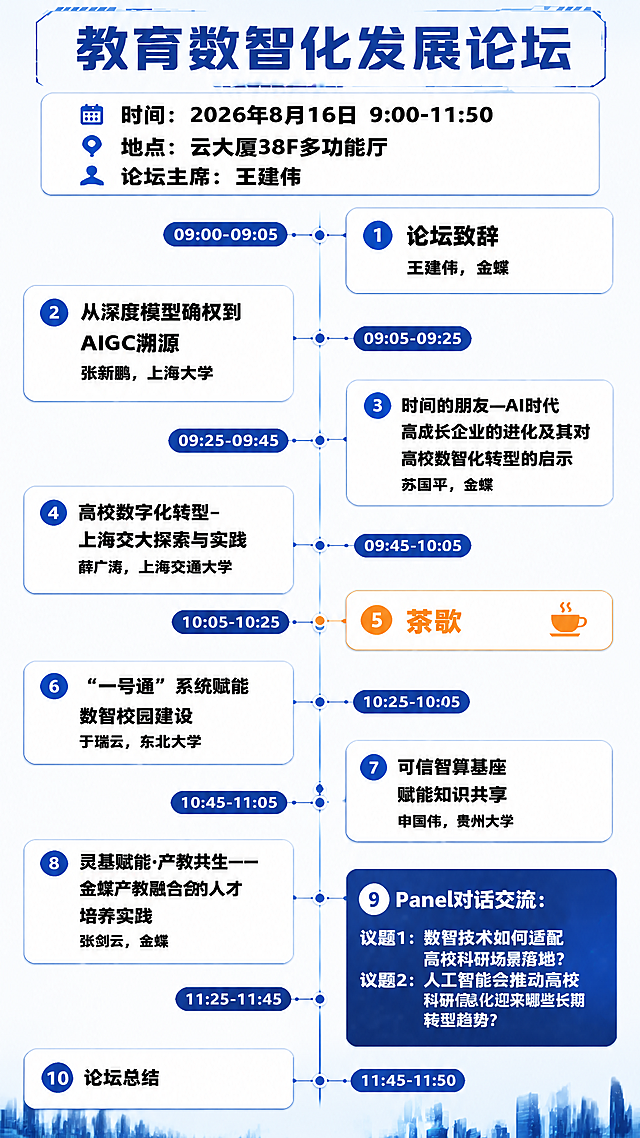
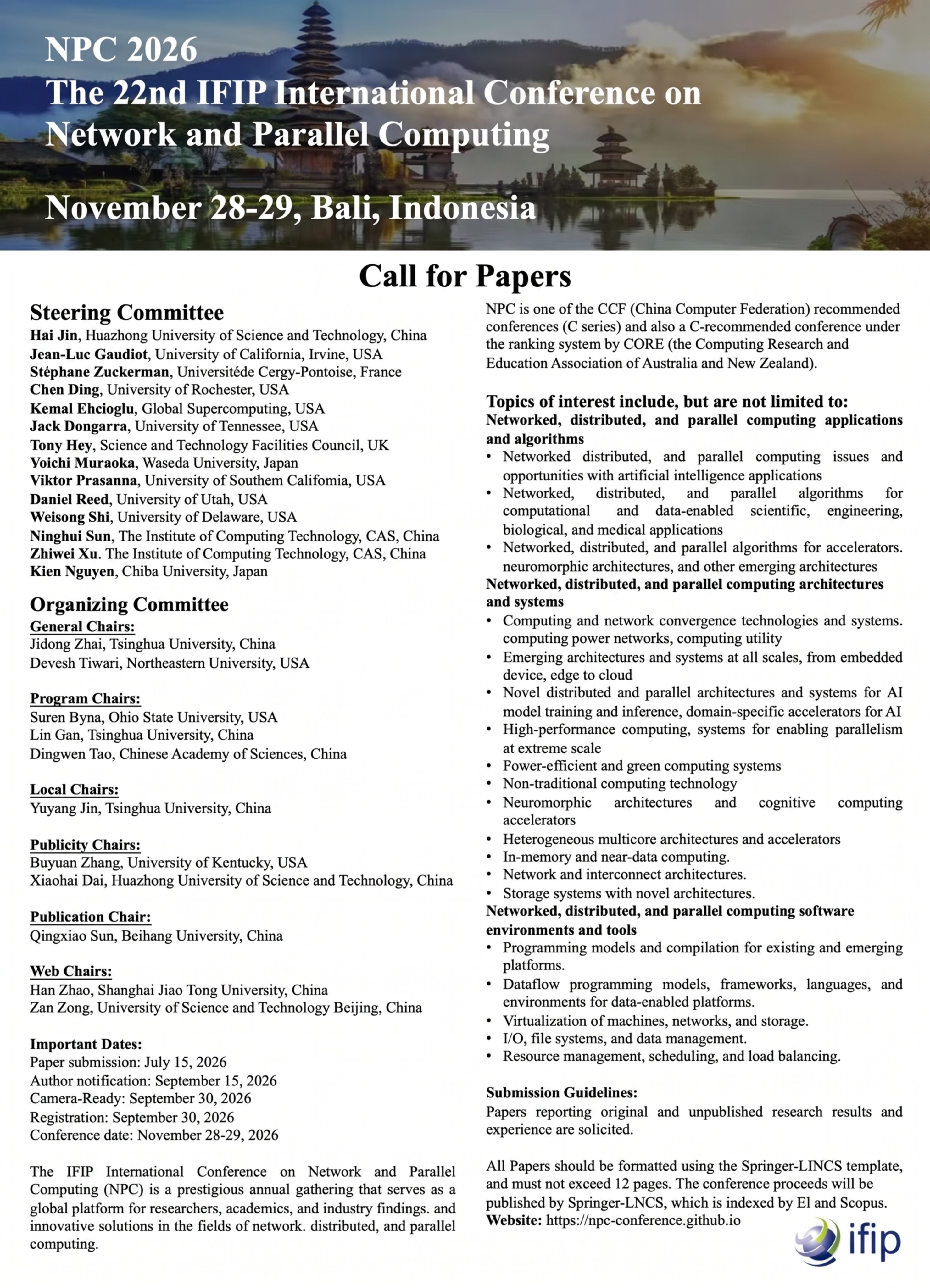
复刻参考图片的内容和排版,制作一模一样的NPC 2026会议征稿海报,包含所有文字信息:标题NPC 2026 The 22nd IFIP International Conference on Net

用户头像

1q2ra2mwknt...

2026.06.12
基于基础海报[image1],保持原蓝白科技学术风格,按照以下要求修改: 1. 在RESEARCH BACKGROUND板块之前新增一个板块,标题为"Abstract",完整添加以下内容: To address two core issues in sliding mode current control for permanent magnet synchronous motors—first, that sliding mode chattering limits control accuracy, and second, the inherent trade-off between chattering suppression and disturbance rejection—this paper proposes a second-order terminal sliding mode control scheme based on a super-twisting reaching law. In the design of the sliding surface, a first-order integral fast terminal sliding surface is embedded into a second-order nonsingular terminal sliding surface structure. This combined design retains the chattering suppression advantage of the former while achieving the fast convergence characteristic of the latter when the system state is near the equilibrium point, and it avoids the singularity problem. In the design of the reaching law, the super-twisting sliding mode algorithm is introduced to further mitigate chattering and achieve fast convergence of the currents with steady-state-error-free tracking. Finally, simulation verification​ is conducted and compared with conventional control methods. The results demonstrate that the proposed scheme offers significant advantages in improving current dynamic response, suppressing chattering, and enhancing disturbance rejection capability. 2. 新增一个板块标题为"Core Method Framework",完整添加以下内容(全部英文): ■ Proposed Control Scheme: STA + STSMC ▎Sliding Surface Design — Second-Order Non-Singular Terminal Sliding Mode Surface Embed the first-order integral fast terminal sliding surface into the second-order non-singular terminal sliding surface structure: First-order sliding variable: s_{1d} = e_d + \int (c_{ed} \cdot e_d + c_{td} \cdot e_d^{\alpha/\beta}) d\tau Second-order sliding variable: s_{2d} = s_{1d} + c_{nd} \cdot (\dot{s}_{1d})^{m/n} Where: • e_d = i_d^* - i_d is the d-axis current tracking error • α, β are positive odd numbers, satisfying α < β • m, n are positive odd numbers, satisfying 1 < m/n < 2 • c_{ed}, c_{td}, c_{nd} are positive coefficients Design Features: ✓ Retains the chattering suppression advantage of the first-order integral fast sliding mode ✓ Has the fast convergence characteristic of the second-order non-singular terminal sliding mode near the equilibrium point ✓ Avoids the singularity problem ▎Reaching Law Design — Super-Twisting Algorithm (STA) Super-twisting sliding mode reaching law expression: \dot{s} = -p \cdot |s|^{1/2} \cdot \text{sign}(s) + y \dot{y} = -i \cdot \int \text{sign}(s) dt Nonlinear control term: u_{sw} = L_0 \cdot [ p \cdot |s|^{1/2} \cdot \text{sign}(s) + \int i \cdot \text{sign}(s) dt ] Design Advantages: ✓ Introduces the sign function into the integral term of the control voltage, which is beneficial to chattering suppression ✓ Ensures fast convergence of sliding variables in finite time ✓ Achieves zero-static-error current tracking 3. 保持画面比例为16:9横版学术海报,调整整体布局保证协调。 4. 新增一个板块标题为"Simulation Verification Results",完整添加以下内容,并将提供的两张对比曲线图[image2]和[image3]并排嵌入此板块,图片整体缩小,两张图片总面积不超过整个海报面积的1/10,保持图片清晰: Simulation Verification and Comparative Analysis Experimental Conditions: • Motor speed: 3000 r/min • d-axis reference current: i_d^* = -50 A (constant) • q-axis reference current: i_q^* steps from 20A to 87A at t=0.02s • Comparison target: conventional exponential reaching law SFTSMC vs. the proposed STA+STSMC Main Conclusions: • The proposed scheme reduces the control voltage chattering amplitude to less than 1/3 of the conventional scheme at rated speed • Effectively solves the problems of low steady-state accuracy and large current fluctuation caused by large chattering in traditional sliding mode current control • Ensures that the motor current state can track the reference signal in finite time 保持原海报的所有已有内容不变,保持原蓝白渐变科技风格一致,保持所有文字为英文,字号协调,公式清晰渲染,所有二维码区域使用纯色方块占位符呈现,方块中央标注"QR Code Placeholder"文字,严禁生成任何可识别的二维码图案,所有文字必须精确渲染,排版整齐美观。基于基础海报[image1],保持原蓝白科技学术风格,按照以下要求修改:

1. 在RESEARCH BACKGROUND板块之前新增一个板块,标题为"Abstract",完整添加以下内容:
To address two core issues in sliding mode current control for permanent magnet synchronous motors—first, that sliding mode chattering limits control accuracy, and second, the inherent trade-off between chattering suppression and disturbance rejection—this paper proposes a second-order terminal sliding mode control scheme based on a super-twisting reaching law.
In the design of the sliding surface, a first-order integral fast terminal sliding surface is embedded into a second-order nonsingular terminal sliding surface structure. This combined design retains the chattering suppression advantage of the former while achieving the fast convergence characteristic of the latter when the system state is near the equilibrium point, and it avoids the singularity problem.
In the design of the reaching law, the super-twisting sliding mode algorithm is introduced to further mitigate chattering and achieve fast convergence of the currents with steady-state-error-free tracking.
Finally, simulation verification​ is conducted and compared with conventional control methods. The results demonstrate that the proposed scheme offers significant advantages in improving current dynamic response, suppressing chattering, and enhancing disturbance rejection capability.

2. 新增一个板块标题为"Core Method Framework",完整添加以下内容(全部英文):
■ Proposed Control Scheme: STA + STSMC

▎Sliding Surface Design — Second-Order Non-Singular Terminal Sliding Mode Surface

Embed the first-order integral fast terminal sliding surface into the second-order non-singular terminal sliding surface structure:

  First-order sliding variable: s_{1d} = e_d + \int (c_{ed} \cdot e_d + c_{td} \cdot e_d^{\alpha/\beta}) d\tau
  Second-order sliding variable: s_{2d} = s_{1d} + c_{nd} \cdot (\dot{s}_{1d})^{m/n}

Where:
  • e_d = i_d^* - i_d is the d-axis current tracking error
  • α, β are positive odd numbers, satisfying α < β
  • m, n are positive odd numbers, satisfying 1 < m/n < 2
  • c_{ed}, c_{td}, c_{nd} are positive coefficients

Design Features:
  ✓ Retains the chattering suppression advantage of the first-order integral fast sliding mode
  ✓ Has the fast convergence characteristic of the second-order non-singular terminal sliding mode near the equilibrium point
  ✓ Avoids the singularity problem

▎Reaching Law Design — Super-Twisting Algorithm (STA)

Super-twisting sliding mode reaching law expression:

  \dot{s} = -p \cdot |s|^{1/2} \cdot \text{sign}(s) + y
  \dot{y} = -i \cdot \int \text{sign}(s) dt

Nonlinear control term:

  u_{sw} = L_0 \cdot [ p \cdot |s|^{1/2} \cdot \text{sign}(s) + \int i \cdot \text{sign}(s) dt ]

Design Advantages:
  ✓ Introduces the sign function into the integral term of the control voltage, which is beneficial to chattering suppression
  ✓ Ensures fast convergence of sliding variables in finite time
  ✓ Achieves zero-static-error current tracking

3. 保持画面比例为16:9横版学术海报,调整整体布局保证协调。

4. 新增一个板块标题为"Simulation Verification Results",完整添加以下内容,并将提供的两张对比曲线图[image2]和[image3]并排嵌入此板块,图片整体缩小,两张图片总面积不超过整个海报面积的1/10,保持图片清晰:

Simulation Verification and Comparative Analysis

Experimental Conditions:
  • Motor speed: 3000 r/min
  • d-axis reference current: i_d^* = -50 A (constant)
  • q-axis reference current: i_q^* steps from 20A to 87A at t=0.02s
  • Comparison target: conventional exponential reaching law SFTSMC vs. the proposed STA+STSMC

Main Conclusions:
  • The proposed scheme reduces the control voltage chattering amplitude to less than 1/3 of the conventional scheme at rated speed
  • Effectively solves the problems of low steady-state accuracy and large current fluctuation caused by large chattering in traditional sliding mode current control
  • Ensures that the motor current state can track the reference signal in finite time

保持原海报的所有已有内容不变,保持原蓝白渐变科技风格一致,保持所有文字为英文,字号协调,公式清晰渲染,所有二维码区域使用纯色方块占位符呈现,方块中央标注"QR Code Placeholder"文字,严禁生成任何可识别的二维码图案,所有文字必须精确渲染,排版整齐美观。
创意 × 2
全英文竖版A0学术海报,主题为"Infinite Series and Its Engineering Applications", subtitle "Simplification of Complex Problems and Engineering Practice Based on Series Approximation". Color scheme: blue and white main tones with orange accents for highlighting. Font: title is Calibri Bold, body is Calibri, formulas are Times New Roman. Top banner centered title. Clear section hierarchy: 1. Top-left section (1/4 page) "Research Background and Core Ideas", text includes core positioning, core idea, core application directions, with minimalist vector: discrete point set fitting continuous curve, label "Discrete → Continuous", decorate with symbols ∑, eˣ, sinx. 2. Top-middle section (1/4 page) "Series Approximation Methods", text description, with table: Taylor Series, Fourier Series, Power Series and core characteristics, text explain core advantages, with three-column contrast vectors: Taylor series (local tangent fitting with formula), Fourier series (sine waves叠加周期曲线 with formula), Power series (expansion in convergence interval with formula). 3. Top-right section (1/4 page) "Method Adaptability and Engineering Value", text includes method adaptation, accuracy-efficiency tradeoff, core engineering value, with vector diagram: left mechanical bearing vibration detection, right building structure stress analysis, center bidirectional arrow "Accuracy ↔ Efficiency". 4. Bottom-left & center section (1/3 page) "Approximation Results and Key Conclusions", text includes three checked core results, key conclusion and future outlook, with info graph: "Core Tool" at center, radiate "Engineering Scenarios", "Technical Advantages", "Future Directions", each with icon (gear, dashboard, AI robot). All text in English, professional academic style, clear layout, technology sense, A0 vertical version.全英文竖版A0学术海报,主题为"Infinite Series and Its Engineering Applications", subtitle "Simplification of Complex Problems and Engineering Practice Based on Series Approximation". Color scheme: blue and white main tones with orange accents for highlighting. Font: title is Calibri Bold, body is Calibri, formulas are Times New Roman. Top banner centered title. Clear section hierarchy: 1. Top-left section (1/4 page) "Research Background and Core Ideas", text includes core positioning, core idea, core application directions, with minimalist vector: discrete point set fitting continuous curve, label "Discrete → Continuous", decorate with symbols ∑, eˣ, sinx. 2. Top-middle section (1/4 page) "Series Approximation Methods", text description, with table: Taylor Series, Fourier Series, Power Series and core characteristics, text explain core advantages, with three-column contrast vectors: Taylor series (local tangent fitting with formula), Fourier series (sine waves叠加周期曲线 with formula), Power series (expansion in convergence interval with formula). 3. Top-right section (1/4 page) "Method Adaptability and Engineering Value", text includes method adaptation, accuracy-efficiency tradeoff, core engineering value, with vector diagram: left mechanical bearing vibration detection, right building structure stress analysis, center bidirectional arrow "Accuracy ↔ Efficiency". 4. Bottom-left & center section (1/3 page) "Approximation Results and Key Conclusions", text includes three checked core results, key conclusion and future outlook, with info graph: "Core Tool" at center, radiate "Engineering Scenarios", "Technical Advantages", "Future Directions", each with icon (gear, dashboard, AI robot). All text in English, professional academic style, clear layout, technology sense, A0 vertical version.
基于基础海报[image1],整合[image2]中的新增板块内容,生成竖版学术海报,尺寸为59.4 cm × 84.1 cm,对应比例约为2:3竖版。要求: 1. 在RESEARCH BACKGROUND板块之前新增完整的Abstract板块,包含用户提供的全部内容 2. 新增完整的Core Method Framework板块,包含所有公式和要点,内容为: ■ Proposed Control Scheme: STA + STSMC ▎Sliding Surface Design — Second-Order Non-Singular Terminal Sliding Mode Surface Embed the first-order integral fast terminal sliding surface into the second-order non-singular terminal sliding surface structure: First-order sliding variable: s_{1d} = e_d + \int (c_{ed} \cdot e_d + c_{td} \cdot e_d^{\alpha/\beta}) d\tau Second-order sliding variable: s_{2d} = s_{1d} + c_{nd} \cdot (\dot{s}_{1d})^{m/n} Where: • e_d = i_d^* - i_d is the d-axis current tracking error • α, β are positive odd numbers, satisfying α < β • m, n are positive odd numbers, satisfying 1 < m/n < 2 • c_{ed}, c_{td}, c_{nd} are positive coefficients Design Features: ✓ Retains the chattering suppression advantage of the first-order integral fast sliding mode ✓ Has the fast convergence characteristic of the second-order non-singular terminal sliding mode near the equilibrium point ✓ Avoids the singularity problem ▎Reaching Law Design — Super-Twisting Algorithm (STA) Super-twisting sliding mode reaching law expression: \dot{s} = -p \cdot |s|^{1/2} \cdot \text{sign}(s) + y \dot{y} = -i \cdot \int \text{sign}(s) dt Nonlinear control term: u_{sw} = L_0 \cdot [ p \cdot |s|^{1/2} \cdot \text{sign}(s) + \int i \cdot \text{sign}(s) dt ] Design Advantages: ✓ Introduces the sign function into the integral term of the control voltage, which is beneficial to chattering suppression ✓ Ensures fast convergence of sliding variables in finite time ✓ Achieves zero-static-error current tracking 3. 新增完整的Simulation Verification Results板块,包含所有实验条件和结论,并排嵌入对比曲线图[image3] (b) STA+STSSMC 和 [image4] (a) STSSMC,缩小两张图片,保证两张图片的总面积不超过整个海报面积的1/10,保持图片清晰 4. Simulation Verification and Comparative Analysis: Experimental Conditions: • Motor speed: 3000 r/min • d-axis reference current: i_d^* = -50 A (constant) • q-axis reference current: i_q^* steps from 20A to 87A at t=0.02s • Comparison target: conventional exponential reaching law SFTSMC vs. the proposed STA+STSMC Main Conclusions: • The proposed scheme reduces the control voltage chattering amplitude to less than 1/3 of the conventional scheme at rated speed • Effectively solves the problems of low steady-state accuracy and large current fluctuation caused by large chattering in traditional sliding mode current control • Ensures that the motor current state can track the reference signal in finite time 保持原蓝白渐变科技学术风格一致,整体版式为竖版多栏布局,协调排版所有板块,保留原海报所有已有文字和作者信息,保持所有文字为英文,字号协调清晰,公式准确渲染,所有二维码区域使用纯色方块占位符呈现,方块中央标注"QR Code Placeholder"文字,严禁生成任何可识别的二维码图案,所有文字精确渲染,保证印刷清晰度。基于基础海报[image1],整合[image2]中的新增板块内容,生成竖版学术海报,尺寸为59.4 cm × 84.1 cm,对应比例约为2:3竖版。要求:

1. 在RESEARCH BACKGROUND板块之前新增完整的Abstract板块,包含用户提供的全部内容
2. 新增完整的Core Method Framework板块,包含所有公式和要点,内容为:
■ Proposed Control Scheme: STA + STSMC

▎Sliding Surface Design — Second-Order Non-Singular Terminal Sliding Mode Surface
Embed the first-order integral fast terminal sliding surface into the second-order non-singular terminal sliding surface structure:
  First-order sliding variable: s_{1d} = e_d + \int (c_{ed} \cdot e_d + c_{td} \cdot e_d^{\alpha/\beta}) d\tau
  Second-order sliding variable: s_{2d} = s_{1d} + c_{nd} \cdot (\dot{s}_{1d})^{m/n}
Where:
  • e_d = i_d^* - i_d is the d-axis current tracking error
  • α, β are positive odd numbers, satisfying α < β
  • m, n are positive odd numbers, satisfying 1 < m/n < 2
  • c_{ed}, c_{td}, c_{nd} are positive coefficients
Design Features:
  ✓ Retains the chattering suppression advantage of the first-order integral fast sliding mode
  ✓ Has the fast convergence characteristic of the second-order non-singular terminal sliding mode near the equilibrium point
  ✓ Avoids the singularity problem

▎Reaching Law Design — Super-Twisting Algorithm (STA)
Super-twisting sliding mode reaching law expression:
  \dot{s} = -p \cdot |s|^{1/2} \cdot \text{sign}(s) + y
  \dot{y} = -i \cdot \int \text{sign}(s) dt
Nonlinear control term:
  u_{sw} = L_0 \cdot [ p \cdot |s|^{1/2} \cdot \text{sign}(s) + \int i \cdot \text{sign}(s) dt ]
Design Advantages:
  ✓ Introduces the sign function into the integral term of the control voltage, which is beneficial to chattering suppression
  ✓ Ensures fast convergence of sliding variables in finite time
  ✓ Achieves zero-static-error current tracking

3. 新增完整的Simulation Verification Results板块,包含所有实验条件和结论,并排嵌入对比曲线图[image3] (b) STA+STSSMC 和 [image4] (a) STSSMC,缩小两张图片,保证两张图片的总面积不超过整个海报面积的1/10,保持图片清晰
4. Simulation Verification and Comparative Analysis:
Experimental Conditions:
  • Motor speed: 3000 r/min
  • d-axis reference current: i_d^* = -50 A (constant)
  • q-axis reference current: i_q^* steps from 20A to 87A at t=0.02s
  • Comparison target: conventional exponential reaching law SFTSMC vs. the proposed STA+STSMC
Main Conclusions:
  • The proposed scheme reduces the control voltage chattering amplitude to less than 1/3 of the conventional scheme at rated speed
  • Effectively solves the problems of low steady-state accuracy and large current fluctuation caused by large chattering in traditional sliding mode current control
  • Ensures that the motor current state can track the reference signal in finite time

保持原蓝白渐变科技学术风格一致,整体版式为竖版多栏布局,协调排版所有板块,保留原海报所有已有文字和作者信息,保持所有文字为英文,字号协调清晰,公式准确渲染,所有二维码区域使用纯色方块占位符呈现,方块中央标注"QR Code Placeholder"文字,严禁生成任何可识别的二维码图案,所有文字精确渲染,保证印刷清晰度。
创意 × 2
重新生成这张技术流程图,标题"From LM-ResNet to MF-LM-ResNet: A Synergy of Accuracy and Efficiency",左面板LM-ResNet (Accuracy Optimization),垂直堆叠6个绿色矩形残差块,每个标记"Residual Block F(x_n)",每个块都有实线红色箭头标记"1 - k_n"来自上一个块输出x_n,虚线橙色箭头标记"k_n"来自上方两个块x_{n-1},旁边展示公式"x_{n+1} = (1-k_n)x_n + k_n·x_{n-1} + F(x_n)",标注框解释"Linear Multi-step: Uses historical state (x_{n-1}) for higher-order accuracy (O(h³))"。中间面板MeanFlow Core Idea (Efficiency Distillation),左侧堆叠的绿色残差块被压缩汇聚到一个大蓝色菱形模块,模块标记"MeanFlow Module: Learns ū_θ",输入公式"ū = 1/Δt ∫ f_LM dt (Average Velocity)",输出公式"x_out = x_in + ū_θ · Δt (Single-step Mapping)",标注框解释"Distillation: Replaces multi-step integration with a learned average velocity field."。右面板MF-LM-ResNet (Accuracy & Efficiency Synergy),简化为2个阶段,每个阶段包含一个蓝色菱形MF模块,保留和左侧相同的双输入结构:红色箭头x_n和橙色箭头x_{n-1}带参数k_n,展示公式"x_{n+1} = (1-k_n)x_n + k_n·x_{n-1} + ū_θ(x_n)",标注框总结"MF-LM-ResNet: Combines LM's accuracy (historical states) with MF's efficiency (single-step per stage)."。底部是对比表格,表头为Model | Parameters | Accuracy | Mechanism,包含LM-ResNet和MF-LM-ResNet两行对比数据。整体为干净极简的技术信息图,白色背景,保持原参考图的布局和配色:绿色原始块、蓝色MeanFlow模块、红色当前路径、橙色历史路径,箭头清晰标注,公式放在整齐方框内,风格和上传参考图一致。重新生成这张技术流程图,标题"From LM-ResNet to MF-LM-ResNet: A Synergy of Accuracy and Efficiency",左面板LM-ResNet (Accuracy Optimization),垂直堆叠6个绿色矩形残差块,每个标记"Residual Block F(x_n)",每个块都有实线红色箭头标记"1 - k_n"来自上一个块输出x_n,虚线橙色箭头标记"k_n"来自上方两个块x_{n-1},旁边展示公式"x_{n+1} = (1-k_n)x_n + k_n·x_{n-1} + F(x_n)",标注框解释"Linear Multi-step: Uses historical state (x_{n-1}) for higher-order accuracy (O(h³))"。中间面板MeanFlow Core Idea (Efficiency Distillation),左侧堆叠的绿色残差块被压缩汇聚到一个大蓝色菱形模块,模块标记"MeanFlow Module: Learns ū_θ",输入公式"ū = 1/Δt ∫ f_LM dt (Average Velocity)",输出公式"x_out = x_in + ū_θ · Δt (Single-step Mapping)",标注框解释"Distillation: Replaces multi-step integration with a learned average velocity field."。右面板MF-LM-ResNet (Accuracy & Efficiency Synergy),简化为2个阶段,每个阶段包含一个蓝色菱形MF模块,保留和左侧相同的双输入结构:红色箭头x_n和橙色箭头x_{n-1}带参数k_n,展示公式"x_{n+1} = (1-k_n)x_n + k_n·x_{n-1} + ū_θ(x_n)",标注框总结"MF-LM-ResNet: Combines LM's accuracy (historical states) with MF's efficiency (single-step per stage)."。底部是对比表格,表头为Model | Parameters | Accuracy | Mechanism,包含LM-ResNet和MF-LM-ResNet两行对比数据。整体为干净极简的技术信息图,白色背景,保持原参考图的布局和配色:绿色原始块、蓝色MeanFlow模块、红色当前路径、橙色历史路径,箭头清晰标注,公式放在整齐方框内,风格和上传参考图一致。